ශ්රී ලංකා තානාපති කාර්යාලය, මොස්කව්, රුසියාව
இலங்கைத் தூதரகம், மொஸ்கோ, ரஷ்யா
The Embassy of the Democratic Socialist Republic of Sri Lanka in the Russian Federation

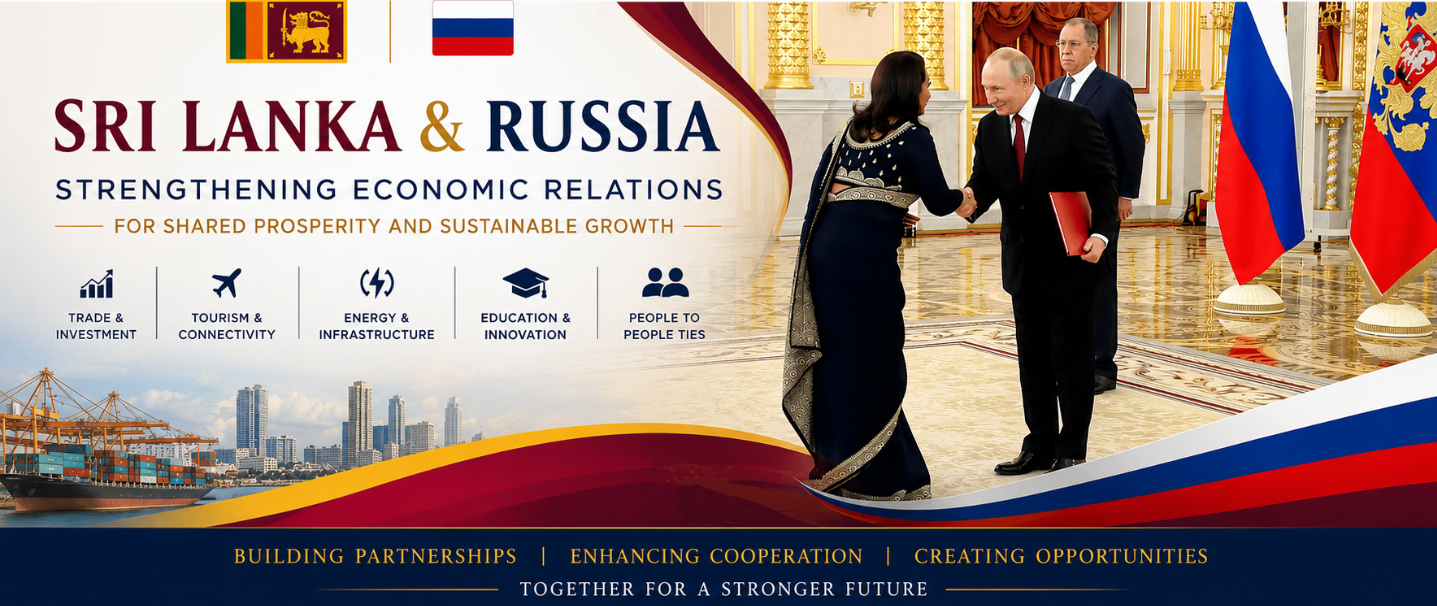
Economic Relations
Sri Lanka – Russia Economic Relations
Total trade between the two countries was USD 570.95 million in 2025. Sri Lanka’s exports to Russia are concentrated in a narrow basket, primarily consisting of tea, apparel, rubber products, and agricultural goods. Among these, Ceylon tea continues to dominate export earnings, sustaining Russia’s position as one of Sri Lanka’s key traditional markets. Imports from Russia, on the other hand, are largely composed of wheat, coal, fertilizers, and other industrial inputs, which are vital to Sri Lanka’s food security, energy security and agricultural productivity.
Being the 3rd largest tourists source, in 2025, Sri Lanka received 186,580 visitors from Russia. Sri Lankan authorities are intensifying targeted promotional campaigns, focusing on diverse segments including MICE, wellness, sports, gastronomy, and niche tourism markets, aiming to attract both high-end and budget-conscious travelers and sustain long-term growth in this sector. Russian tourists are especially significant during the winter season, contributing to the stability of Sri Lanka’s tourism industry. Charter flights and targeted promotional campaigns have further supported this inflow. Strengthening tourism cooperation through enhanced connectivity, simplified visa processes, and joint marketing initiatives remains a key priority for both nations.
Beyond trade, labor mobility remains an important pillar of bilateral engagement. Approximately 3,500 Sri Lankan workers are currently employed in the Russian Federation under government quota arrangements, with around 80% engaged in apparel manufacturing and the remainder in agriculture and other industrial sectors. Special Economic Zones and industrial hubs in Russia present promising avenues for structured labour migration. Institutional collaboration, including government-to-government agreements and regulatory frameworks, will be essential to ensure worker protection, skills matching, and sustainable employment pathways.
Sri Lanka – Uzbekistan Economic Relations
Beyond trade, labor mobility remains an important pillar of bilateral engagement. Approximately 3,500 Sri Lankan workers are currently employed in the Russian Federation under government quota arrangements, with around 80% engaged in apparel manufacturing and the remainder in agriculture and other industrial sectors. Special Economic Zones and industrial hubs in Russia present promising avenues for structured labour migration. Institutional collaboration, including government-to-government agreements and regulatory frameworks, will be essential to ensure worker protection, skills matching, and sustainable employment pathways.
Uzbekistan was the 94th export destination for Sri Lanka in 2025, while it ranked as the 44th import origin for Sri Lanka during the same period. Sri Lanka’s total exports to Uzbekistan reached USD 6.16 million in 2025, whereas imports from Uzbekistan amounted to USD 30.21 million.
Sri Lanka’s exports to Uzbekistan are predominantly agricultural and agro-based products. Key export items in 2025 included Packed Tea, Tea in Bulk, Coco Peat, Fiber Pith and Moulded Products, Coconut Husk Chips, Plants and Parts of Plants, Yarn, and Printed Labels. Among these, Ceylon tea continues to maintain a strong presence and recognition in the Uzbek market.
In 2025, Sri Lanka officially offered landlocked Uzbekistan access to Sri Lankan seaports to facilitate the transit of Uzbek products to international markets. The initiative underscored Sri Lanka’s strategic location in the Indian Ocean and its growing role as a regional logistics and maritime hub linking Central Asia with global trade routes.
Sri Lanka has also actively supported Uzbekistan’s integration into the global economy. During the negotiations on Uzbekistan’s accession to the World Trade Organization, Sri Lanka collaborated closely with the Uzbek side and welcomed the signing of the Protocol of Agreement on Uzbekistan’s WTO accession in 2024.
Business engagement between the two countries continues to grow. In April 2026, Uzbekistan’s Ambassador to Sri Lanka, resident in Islamabad, held online discussions with the National Chamber of Commerce of Sri Lanka to explore avenues for enhanced cooperation. Agriculture, textiles, logistics, pharmaceuticals, and tourism were identified as priority sectors for bilateral collaboration.
Sri Lanka – Kazakhstan Economic Relations
Beyond trade, labor mobility remains an important pillar of bilateral engagement. Approximately 3,500 Sri Lankan workers are currently employed in the Russian Federation under government quota arrangements, with around 80% engaged in apparel manufacturing and the remainder in agriculture and other industrial sectors. Special Economic Zones and industrial hubs in Russia present promising avenues for structured labour migration. Institutional collaboration, including government-to-government agreements and regulatory frameworks, will be essential to ensure worker protection, skills matching, and sustainable employment pathways.
Sri Lanka’s exports to Kazakhstan reached USD 6.58 million in 2025, whereas imports from Kazakhstan amounted to USD 1.19 million during the same period, resulting in a favorable trade balance for Sri Lanka. Kazakhstan was the 91st export destination for Sri Lanka in 2025, while also ranking as the 91st import origin for Sri Lanka in 2024.
Sri Lanka’s exports to Kazakhstan are led by tea sector, with Tea in Bulk and Tea Packets continuing to enjoy strong demand in the Kazakh market. Other notable exports include Coco Peat, Fiber Pith and Moulded Products, Men’s Outerwear, Yarn, Toys, Games and Sports Requisites, Ornamental Fish, Frozen Fish, and Aircrafts & Parts. These exports demonstrate Sri Lanka’s growing diversification beyond traditional agricultural products and highlight opportunities for value-added manufacturing and niche exports.
Imports from Kazakhstan to Sri Lanka mainly consist of Mineral Products, Organic Chemicals, Made-up Textile Articles such as blankets, rugs, linen and curtains, Labels, Metal based Products, Alcoholic Beverages, and Plastic Products.
Tourism has also emerged as a key pillar of bilateral economic engagement. Air Astana frequently operates direct seasonal charter flights between Almaty International Airport and Bandaranaike International Airport in Colombo during the winter season from December to late March, significantly enhancing people-to-people connectivity. In 2025, Sri Lanka welcomed approximately 10,500 tourists from Kazakhstan, reaffirming the island’s growing popularity among Kazakh travelers seeking tropical leisure destinations.
Sri Lanka – Belarus Economic Relations
Beyond trade, labor mobility remains an important pillar of bilateral engagement. Approximately 3,500 Sri Lankan workers are currently employed in the Russian Federation under government quota arrangements, with around 80% engaged in apparel manufacturing and the remainder in agriculture and other industrial sectors. Special Economic Zones and industrial hubs in Russia present promising avenues for structured labour migration. Institutional collaboration, including government-to-government agreements and regulatory frameworks, will be essential to ensure worker protection, skills matching, and sustainable employment pathways.
Belarus emerged as the 103rd export destination for Sri Lanka in 2025, reflecting the growing commercial engagement between the two countries. Total exports from Sri Lanka to Belarus reached USD 3.97 million in 2025, while imports from Belarus to Sri Lanka amounted to USD 0.43 million during the same period. Belarus ranked as the 108th import origin for Sri Lanka in 2025.
Sri Lanka’s key exports to Belarus in 2025 included Tea Packets, Mixed Coir Fiber, Pneumatic and Retreated Rubber Tyres & Tubes, Plants and Parts of Plants, Cinnamon, Coco Peat, and Coconut Husk Chips. These products demonstrate Sri Lanka’s strengths in agricultural, plantation-based, and value-added export sectors, with Ceylon Tea continuing to enjoy strong recognition among Belarus consumers.
Meanwhile, Sri Lanka’s imports from Belarus primarily consisted of Inorganic Chemicals, Fertilizers, Electrical and Electronic Products, Printed Labels, and Plastic Products. The trade profile reflects opportunities for further diversification and increased business collaboration in manufacturing, agriculture, chemicals, logistics, and technology-related sectors.
Belavia, the national carrier of Belarus, commenced charter flight operations to Sri Lanka during the winter season in October 2025, contributing positively to inward tourists flow to Sri Lanka. In addition, the recent signing of an Air Services Agreement between Sri Lanka and Belarus is expected to facilitate enhanced direct air connectivity and create new opportunities for trade and tourism cooperation.
Sri Lanka recorded 10,531 tourist arrivals from Belarus in 2025, indicating increasing interest among Belarus travelers.
Approximately 3,000 Sri Lankan students are currently pursuing higher education in Belarus universities, particularly in the field of medicine. This long-standing academic engagement has contributed significantly to strengthening mutual understanding and professional links of the two countries.